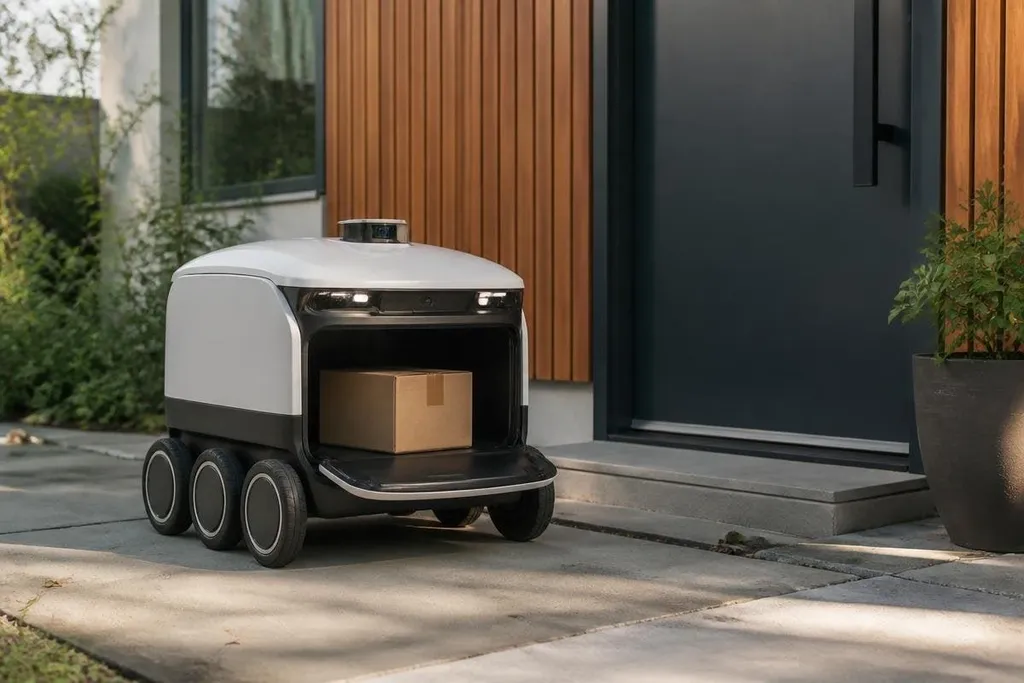
Last-mile robots need to move goods through public spaces, reach the right door, and finish the handoff without constant help. The supplied material names no robot, company, test, price, or date, so this article sets out the changes worth watching rather than declaring a winner.
- Door handoff: Watch for proof that a robot can finish delivery without a worker beside it.
- Public routes: Check how the system handles curbs, crossings, blocked paths, and people.
- Useful cost: Ask how many deliveries one robot can complete before charging or service.
Robots that finish the handoff
A delivery robot can carry a parcel across a route and still fail at the last metre. The useful advance will be a system that can reach a porch, locker, reception desk, or other agreed drop point with a clear record of the handoff.
That record might come from a camera image, a code scan, a customer message, or a worker check. The proof needs to show the full task, including the moment when the parcel leaves the robot. A short clip of movement says little about delivery work.
The hard part is often access. A robot may reach a building but have no way to open a gate, call a lift, or deal with a locked entrance.
Watch for designs that state the delivery boundary in plain terms, because a system that stops at the pavement serves a different job from one that reaches a door.
Better movement in public spaces
Last-mile routes change every few minutes. A parked vehicle can block a path, road work can remove a crossing, and a person may step into the robot’s route. Autonomous systems need sensors and software that let them stop, wait, choose another path, or ask for help.
The useful proof is a dated test with a stated route and clear limits. Look for details such as travel distance, operating speed, weather, pedestrian traffic, remote help, and the number of completed trips. Without those details, a smooth demonstration leaves too many questions open.
Route trials and service limits matter most when a delivery robot leaves a test area. Last-mile robotics reporting from Robot24.com can connect each claim to the route, date, and human help recorded during the job.
More work from each robot
A fleet only helps if each robot spends enough time carrying parcels. The figures that matter are payload, battery runtime, charging time, route length, remote-operator workload, and service visits.
Those figures need a common task. A robot that carries one small parcel on a short route cannot be compared fairly with one that carries several parcels across a larger delivery area. The source should state the parcel size, route, weather, and human support used during the test.
Cost also reaches beyond the purchase price. The full figure may include charging equipment, remote supervision, mapping, insurance, repairs, and staff who load or retrieve parcels. A low hardware price can still lead to high delivery cost if each trip needs close human attention.
What remains unproven
The biggest claims in last-mile robotics often concern scale, safety, and customer acceptance. Those claims need records from repeated service, not one successful run.
A useful report should show how the robot handles failed deliveries, damaged parcels, blocked routes, poor visibility, and a loss of network access. It should also say who can take control and how quickly a human can reach a stranded robot.
I'd wait for repeated route data before calling any last-mile robot a major advance. The machine must complete the boring cases too, because those cases decide the cost of real delivery work.
A practical watch list
Use these checks when a company announces a new delivery robot:
- Name the task: Does it carry food, parcels, groceries, or another load?
- Check the route: Is the test on a private site, a pavement, a road crossing, or a full delivery area?
- Count human actions: How often does a remote worker guide, approve, or recover the robot?
- Find the failure data: Are stopped, delayed, rejected, or damaged deliveries included?
- Price the service: Are charging, repairs, software, supervision, and insurance in the cost?
- Set the proof bar: Does the company give dates, route details, payload, runtime, and completed trips?
The next useful evidence will be a named deployment with public route data, delivery results, and service costs. Until those numbers appear, the strongest breakthrough to watch is a complete handoff that works repeatedly without hiding the human work behind it.